




- En
- Fr
- عربي



THE REAL COMPETITION Technology, Order, and the Contest to Shape the Twenty-First Century
THE REAL COMPETITION Technology, Order, and the Contest to Shape the Twenty-First Century
Introduction
The most valuable cargo ever brought to American shores was not gold, not weapons, and not men. It was a device the size of a hockey puck, sealed inside a black metal deed box, carried across the Atlantic in September 1940 by a small British scientific delegation that most of official Washington did not know existed. The device was called a cavity magnetron. It made microwave radar possible. British scientists had invented it, tested it, and understood that it could decide the war. What they could not do, while their factories burned under German bombardment, was manufacture it at scale.1
Within eighteen months, the MIT Radiation Laboratory had turned that single prototype into a production program that would deliver over 150 different radar systems to Allied forces. The same pattern repeated itself with uncanny precision across the technologies that would decide the war. Alexander Fleming had discovered penicillin in London in 1928; Howard Florey and Ernst Boris Chain worked out how to extract it in Oxford. But Britain could not produce it in quantity. American scientists at the USDA laboratory in Peoria, Illinois, found the deep-tank fermentation method that made mass production possible, and by D-Day, American factories were shipping enough penicillin to treat every wounded soldier on the beaches of Normandy.
The Tizard Mission, as it became known, is not merely a war story. It is a parable about the relationship between invention and power, and the lesson it carries has never been more urgent. Britain was the most inventive nation on earth in 1940. It was also losing the war. What saved it was not another breakthrough in a Cambridge laboratory but the institutional capacity of another country to translate breakthroughs into deployed capability at industrial scale: to convert. The order that emerged after 1945, the institutions, alliances, and norms that governed international life for seven decades, was not built by the nations that innovated most brilliantly. It was built by the nation that converted most effectively. The world is entering a comparable moment now. The technologies of the sixth wave, artificial intelligence, biotechnology, clean energy, quantum computing, are arriving simultaneously, and the states that convert them into deployed systems, standards, and governance architectures will write the rules of twenty-first-century international life.

I. THE UNDERLYING QUESTION
The international order built after 1945 is under simultaneous pressure from without and within. Great-power rivalry, paralysis in multilateral bodies, the rise of privately controlled strategic infrastructure: these are not separate stories. They are interacting mechanisms of a single systemic transition. Helen Thompson has shown that the biggest shocks in modern history arise not from any single failure but from the collision of energy systems, monetary systems, and democratic systems, overlapping structural fault lines that policymakers insist on treating as separate files.2 Kissinger argued in A World Restored that the test of statesmanship lies in recognizing the real relationship of forces and making this knowledge serve considered ends. Today, that relationship is being reshaped not primarily by military balance or GDP rankings but by what this essay calls conversion capacity: the institutional ecosystem that connects technological invention to large-scale deployment, standards-setting, and governance.3
Barry Buzan and George Lawson have argued that changes in the mode of power, what power consists of and how it is organized, matter more than changes in its distribution. The current systemic transition fits that description. It is a transformation in what constitutes usable power, not merely in who holds it.4 The World Economic Forum’s Global Risks Report 2026 confirms the scale: geoeconomic confrontation has displaced armed conflict as the risk most likely to trigger a material global crisis. Sixty-eight percent of respondents described the likely political environment as multipolar or fragmented; only six percent expected reinvigoration of unipolarity.5 The question is not, as Michael Beckley has argued, whether the existing order is merely stagnant.6 The question is whether the institutional mechanisms that connect innovation to deployment, standards, and governance can be rebuilt before the window of deliberate construction closes.
Every period of genuine systemic transition has forced statesmen to answer this question. Morgenthau warned against the fallacy of the single factor: the recurring temptation to reduce national power to one variable. The Congress of Vienna succeeded where Versailles failed because Metternich and Castlereagh understood that durable order requires the incorporation of defeated powers. Legitimacy, as Kissinger showed, is not the satisfaction of every party but the acceptance by each that the system’s arrangements are not fundamentally unjust.7
Three pressures now converge. External revisionism led by China and Russia. Internal disenchantment within democracies, most visible in American ambivalence about the order Washington built. And structural diffusion of power toward a Global South that increasingly declines to organize its foreign policy around Western preferences. The Munich Security Report 2026 describes the current wave of disruption as deliberate institutional demolition rather than incremental erosion. At Davos in January 2026, Canadian Prime Minister Mark Carney declared a “rupture” in transatlantic relations. Finnish President Alexander Stubb, writing in Foreign Affairs, chose a different word: “transition.” A rupture implies severance; a transition implies institutional resilience sufficient to adapt. Whether the current moment is one or the other depends on conversion capacity: the ability to translate disruption into new institutional arrangements rather than simply absorbing it.8
This essay argues that the decisive competition of this era is over conversion capacity: the ability to move from invention and capital to production, deployment, and governance at scale, quickly, repeatedly, and under stress. States and coalitions that can convert will shape standards, supply chains, and security environments. Those that cannot will remain innovative but strategically brittle.

II. CREATIVE DESTRUCTION AND INTERNATIONAL ORDER
Schumpeter understood that the competition which counts is not the competition between firms operating within established rules but the competition to define the rules themselves.9
Applied to geopolitics, the competition that matters most is between powers seeking to define what rules govern the system. The Munich Security Report 2026 poses the question starkly: is the current disruption creative destruction or merely destruction? Schumpeter’s entrepreneurs create value by building new combinations; states that merely dismantle institutional frameworks without constructing replacements produce disorder, not order.
Hayek grasped something complementary. The most important knowledge in any economy is dispersed, embedded in local conditions and tacit understandings; no central authority can aggregate it effectively.10
In The Fatal Conceit, he drew the distinction between cosmos, spontaneous order, and taxis, order deliberately constructed. The post-1945 system succeeded because it created space for spontaneous coordination among diverse actors whose participation reinforced the system’s legitimacy. But one must be careful not to draw the wrong inference. Acemoglu and Johnson have demonstrated that there is nothing automatic about new technologies generating widespread prosperity; whether they do so is an economic, social, and political choice.11 Innovation may generate extraordinary output while concentrating returns so narrowly that the political foundations of order erode from within. Piketty documented the mechanism: when the private rate of return on capital persistently exceeds the growth rate, past wealth dominates new production, and the political economy shifts from broad-based dynamism to patrimonial stabilization.12 In a world where frontier economies grow at perhaps 1 to 1.5 percent, Piketty’s r > g condition already operates in economies where growth has settled below two percent, and the political consequences compound with every electoral cycle.
Gilpin formalized the logic for international politics: differential growth rates, driven by technological dynamism, gradually shift the balance of power.13 Aghion and his co-authors documented a telling parallel. When electricity arrived in American factories in the late nineteenth century, it initially produced no measurable productivity gains because firms retained the organizational structure of the steam era. Only when Henry Ford realized that electric motors made machines independent of each other could the assembly line be born.14 The lesson for the AI revolution is direct: frontier capability means little without the secondary innovations, in infrastructure, organization, regulation, and workforce, that constitute conversion.
The historical record reinforces the point across millennia. Rome converted military dominance into legal codes and infrastructure that outlasted the legions. The Han tributary system sustained Chinese influence through cultural and bureaucratic authority. In each case, the order-shapers were not the strongest military powers; they were the most effective converters of capability into institutional architecture. A heuristic from Carlota Perez’s work is useful here: each technological revolution moves through recognizable phases, and the current moment sits at a turning point between the fifth wave and the sixth. The CFR’s flagship task force report on economic security arrived at a convergent conclusion: first movers in technology do not always become dominant, but they are more likely to establish enduring advantages if they are also fast scalers.15
III. CONVERSION CAPACITY
There is an assumption worth questioning in much strategic thinking: that the most transformative technologies always matter most where they are invented. In practice, there is a critical difference between innovation and transformation, and deployment is where transformation sits. The shipping container required no new science, just standardization. SpaceX’s reusable rockets relied on fifty-year-old mathematics applied through integration breakthroughs. Chris Miller’s history of the semiconductor industry drives the point home: the actor that invents first is often not the actor that dominates. What determines strategic effect is not theoretical discovery but engineering discipline, process control, yield improvement, and the orchestration of complex supplier ecosystems.16
Conversion capacity comprises four measurable abilities. Innovation-to-production: the time and failure rate between prototype and mass manufacture. Capital-to-infrastructure: the ability to build power, logistics, and industrial inputs fast enough to match new demand. Decision-to-execution: the throughput of permitting, procurement, and mobilization systems. And legitimacy-to-durability: the capacity to sustain contested investments long enough for compounding returns to appear.
The concept is falsifiable. If states with high conversion capacity do not shorten deployment timelines, maintain resilience under disruption, or propagate standards through coalitions, the thesis is weakened. If a state with low conversion capacity nonetheless shapes order through other means, the thesis requires revision. The concept must also be bounded. Conversion capacity is not military power, though military power creates the competitive space within which conversion operates. It is not raw capital, though capital is one input. It is not legitimacy, though legitimacy is one output. It is the institutional throughput between inputs and outcomes: the speed, reliability, and adaptability with which a system translates what it possesses into what it deploys. A country can be rich, inventive, and militarily dominant while remaining conversion-poor, as the United States currently demonstrates in infrastructure permitting. A country can be conversion-strong in one domain and conversion-weak in another, as China demonstrates in solar deployment versus advanced semiconductor fabrication. There is also a necessary complement, what Suleyman has called containment capacity: the ability to keep a grip on powerful technologies as they become cheaper and more widely distributed.17 A system may excel at converting technology into deployment yet fail catastrophically at containing the risks that follow. The two capacities are in structural tension, and managing that tension is what governance is ultimately for.
The nearest historical analogue is the World War II synthetic rubber program. When Japan cut off Southeast Asian natural rubber supplies, the United States invented a synthetic substitute and scaled it through public-private partnerships, exceeding natural supply within two years. That was conversion capacity under existential pressure: not breakthrough science but institutional orchestration at speed.
Morgenthau argued that all elements of national power are merely raw material; the quality of diplomacy combines them into an integrated whole. His insistence that diplomacy functions as the brain of national power anticipates the integrative logic of conversion capacity, even if his framework could not have foreseen its technological dimensions.18 Mazarr’s recent RAND study reaches a convergent conclusion: the competitive challenge of AI is primarily social, not technological. Carlsson-Szlezak and Swartz arrive at the same insight from the macroeconomic direction: the post-Cold War convergence bubble burst precisely where institutional depth was shallowest.
Conversion capacity occupies an analytical space that several adjacent literatures approach but none claims. National innovation systems theory, Mazzucato’s entrepreneurial state, and Beckley’s power conversion metric each capture a piece of the puzzle without theorizing the institutional ecosystem as a variable in order formation.19 Conversion capacity does: not merely who innovates or who grows, but who deploys, who sets standards, and who constructs governance frameworks that others either adopt or resist. The argument carries a scope condition. Ikenberry has documented a pattern in which durable institutional orders follow decisive military outcomes, though the pattern is strongest for 1815 and 1945.20 Conversion capacity is not a replacement for military capability but a theory of what determines outcomes within the competitive space that military power and nuclear deterrence create.

IV. THE MATERIAL FOUNDATIONS
Every technological revolution rests on a material substrate. For the current wave, that substrate includes critical minerals underpinning batteries, magnets, advanced electronics, and clean-energy infrastructure. Ed Conway has demolished the notion that the modern economy is somehow dematerializing, a claim that the commoditization of software by artificial intelligence has rendered less defensible still: in every year since 2012, humanity has extracted more material from the earth than the total extracted from the dawn of civilization through 1950.21 The green transition is not dematerialization; it is rematerialization, shifting the structure of extraction rather than abolishing it. These systems are better understood as interwoven material webs than as linear supply chains, because disruption in one substrate cascades unpredictably through others.
Rare earths illustrate conversion capacity as chokepoint control. Rare earths are not rare; they are found across multiple continents. The chokepoint is processing and refining, not geological endowment. For magnet-grade rare earths, China accounted for roughly sixty percent of global mining output in 2024, but its dominance is far larger downstream: approximately ninety-one percent of separation and refining and approximately ninety-four percent of permanent magnet manufacturing.22 In October 2025, China announced its first-ever foreign direct product rule for rare earths, imposing zero-threshold export license requirements on products containing controlled heavy rare earth elements and categorically denying applications for military end-users. European prices for heavy rare earths such as dysprosium subsequently reached up to six times Chinese domestic prices.23 The decisive bottleneck sometimes sits in obscure places. Conway documents that a single source of high-purity quartz in Spruce Pine, North Carolina, is indispensable for crucibles used in monocrystalline silicon wafer production; disruption there would cascade through both semiconductors and solar panels.24 The United States currently maintains one manufacturer of rare earth magnets.25
China’s rapid scale-up in electric vehicles provides the strongest case for directed mobilization as a path to technological dominance. China represents approximately eighty-five to ninety percent of global cathode and anode manufacturing capacity, yet the lithium-ion battery was developed through multinational contributions recognized by the Nobel Prize in Chemistry 2019.26 China’s triumph was in paradigm deployment, not paradigm creation. The distinction matters. The state that deploys existing technologies most efficiently may dominate one industry, but the state that generates entirely new technological trajectories across multiple domains will define the architecture of the next order. While the United States frames the AI competition in terms of artificial general intelligence, China is racing on a different course: what Xi Jinping calls “application-oriented” AI, wiring intelligence into manufacturing, logistics, and infrastructure at scale. The competition is not symmetric; each side is optimizing for a different conversion pathway.

This demands a distinction between two modes of innovation. Generative innovation depends on error correction, permissive feedback, and institutional tolerance for failure across domains. It flourishes where dissent is tolerated, capital can flow to unconventional ideas, and failure is treated as information rather than punished as disloyalty. Directed innovation can excel at rapid mobilization within defined problem sets but faces recurring constraints in open-ended, cross-domain experimentation. One-man rule, as Kotkin has observed, is susceptible to compounding miscalculations in a way that competitive governance is not.27 The technologies of the sixth wave are interdependent: semiconductors enabling AI, materials science enabling next-generation chips, AI accelerating discovery in materials and biology. Miller’s semiconductor history demonstrates that chip power is rarely held by a single nation-state; it is distributed across a specialized transnational system encompassing U.S. design software, Dutch lithography, German optics, Taiwanese fabrication, Korean capacity, and Japanese materials. The conversion problem is therefore not “who has the best model” but “who can build the deployable system, reliably, at scale, with trusted governance.”
The record requires acknowledging what China has already converted. One trillion dollars invested in clean energy in 2025. Clean energy sectors representing approximately 11.4 percent of GDP and driving more than a third of GDP growth. In the first half of 2025 alone, 256 gigawatts of solar capacity were installed, more than double the rest of the world combined.28 This is conversion capacity of the highest order, achieved under authoritarian governance. The question the thesis must answer is not whether authoritarian states can convert, because demonstrably they can, but whether authoritarian conversion sustains across paradigm shifts and generates international order rather than merely national power. The evidence is mixed, and the distinctions matter. China’s conversion triumphs cluster in defined problem sets: solar panels, batteries, EVs, high-speed rail, 5G infrastructure. Where the problem set is open-ended and cross-domain, the record is weaker. Despite more than $150 billion in cumulative semiconductor subsidies, China’s most advanced domestic chips remain two to three generations behind TSMC’s frontier nodes. The COMAC C919, after nearly two decades of development, still depends on Western engines and avionics. These are not random failures; they are failures at the precise points where conversion requires cross-domain integration, tacit knowledge transfer, and iterative supplier ecosystems that directed mobilization struggles to command. Solar manufacturing capacity for 2030 already exceeds projected global demand by roughly sixty-five percent. And the structural difficulty of translating domestic deployment into trusted international governance that third parties join voluntarily remains the deepest constraint of all.
V. THE AMERICAN PARADOX
If concentrated authority faces a structural deficit in generative innovation, the United States faces a different but equally dangerous trap. America leads the world in frontier AI research, breakthrough biotechnology, and quantum computing. But its conversion capacity is strategically constrained by throughput bottlenecks, and the gap is measurable. Average permitting timelines for major energy infrastructure in the United States now exceed four years; China builds comparable facilities in twelve to eighteen months. The average Pentagon major weapons system takes twenty-two years from program start to initial operating capability. Together, they describe a system that converts at a fraction of its potential. Carlsson-Szlezak and Swartz have identified the structural illusion: the post-Cold War era was shaped by what they call a convergence bubble, a temporary alignment of conditions that policymakers mistook for a permanent order.29 The convergence bubble burst because its institutional underpinnings were shallow. Hegemony without conversion capacity is a bubble.
The weaponization of interdependence has compounded the problem. Farrell and Newman have documented how the United States weaponized the networks upon which the liberal order depended, incentivizing the rest of the world to construct alternatives.30 Fishman’s study of economic warfare reveals the mechanism: coercive power operates through the “invisible infrastructure” of globalization, dollar settlement, correspondent banking, SWIFT messaging, maritime insurance, and the modern world faces what Fishman describes as an impossible trinity in which economic interdependence, economic security, and geopolitical competition cannot all be sustained simultaneously.31 Blinken’s “strategy of renewal” documents the institutional logic the conversion thesis predicts: the Inflation Reduction Act, CHIPS and Science Act, and Infrastructure Investment and Jobs Act represent the largest domestic conversion investment since the postwar era.
There is a deeper problem still. Keohane’s original framework for cooperation after hegemony anticipated a declining hegemon that still broadly supported the regime. He did not anticipate a hegemon actively trying to dismantle the regime it built. The shift in burden-sharing on Ukraine offers a revealing empirical test: European allies have provided approximately 165 billion euros in Ukraine aid through mid-2025, while total U.S. appropriations reached an estimated 115 billion euros ($126 to 134 billion).32
The physical infrastructure required for the AI revolution compounds the paradox. Frontier AI increasingly depends on hyperscale compute controlled by a handful of firms; OpenAI’s dependence on Microsoft’s infrastructure and Anthropic’s dependence on Google and Amazon cloud credits demonstrate that compute has become a chokepoint.33 Major cloud providers are projected to spend between $635 and $715 billion on capital expenditure in 2026, roughly three-quarters directed at AI infrastructure. Data centers coming online before 2030 may require between 400 and 600 terawatt-hours of electricity.34 Section 232 actions raised steel and aluminum tariffs to fifty percent, raising delivered costs for the grid inputs needed to deliver that power.
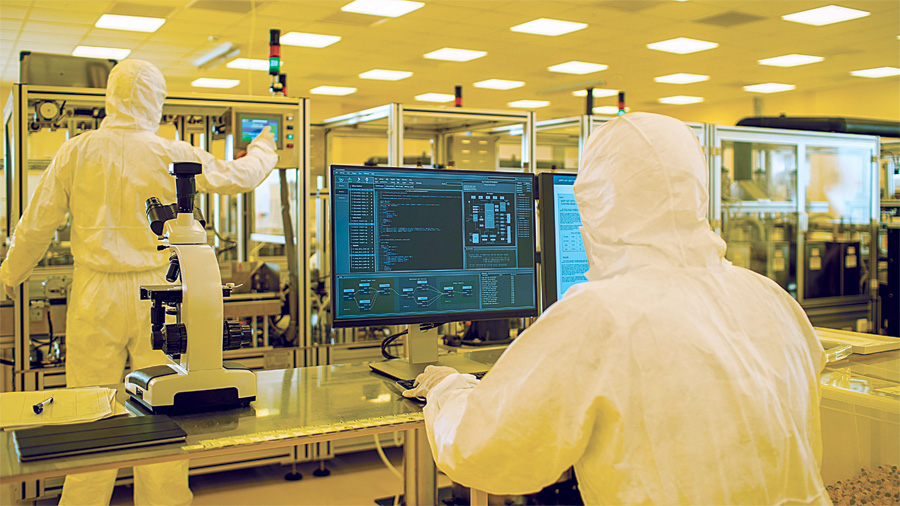
The semiconductor supply chain illustrates the conversion challenge in its operational phase. TSMC’s Arizona fabrication facility entered high-volume advanced-node production in late 2024 ahead of schedule, with yields described by the company as comparable to Taiwan plants and total U.S. investment announced at $165 billion. But Intel’s foundry recorded a $2.3 billion operating loss in early 2025, the CHIPS Act expires in 2027 with no renewal certain, and federal R&D funding has flattened since the 1980s. Current cuts to NIH and NSF amount to harvesting seeds planted a generation ago while ceasing to plant new ones.35 Meanwhile, as Economy has observed, China now maintains more embassies and consulates than any other country, converting diplomatic presence into standard-setting influence while Washington debates whether to fund its own scientific infrastructure.
VI. WAR, TECHNOLOGY, AND PRIVATE POWER
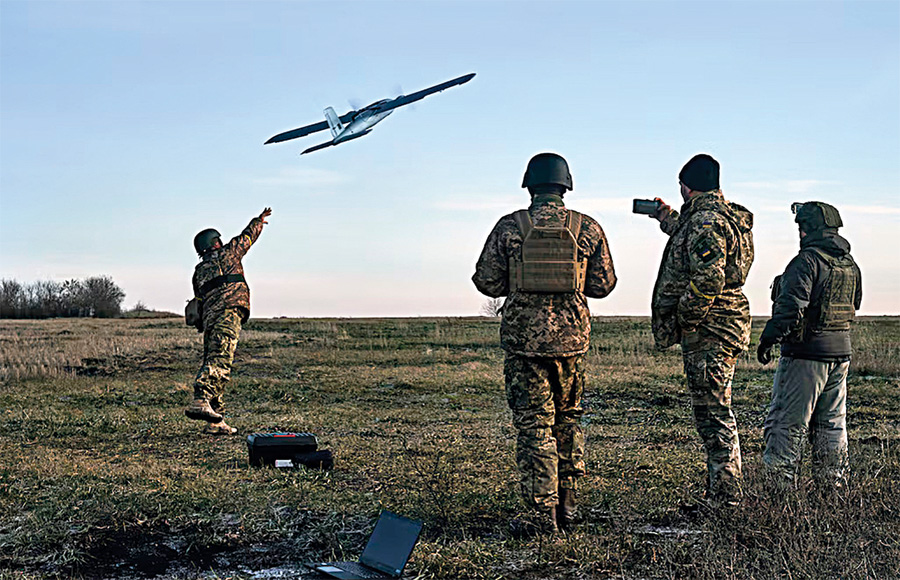
The war in Ukraine is more than a regional conflict. It is a stress test for conversion capacity under fire: for the defense industrial base, for alliance coordination, and for the credibility of the norms underpinning international order. The first lesson is one that post-Cold War planning had wished away: nuclear weapons remain decisive instruments of political coercion. The second concerns attrition: protracted conventional warfare consuming munitions at rates not seen since 1945 remains possible when both sides have sufficient motivation and external support. Third, the battlefield has become a laboratory of adaptation and counter-adaptation in which tactical innovations can become obsolete within weeks.
Ukrainian drone production reached four to four-and-a-half million units in 2025, with a target of seven million for 2026.36 Drone-related casualties now account for the majority of front-line losses, with first-person-view one-way attack systems costing as little as ten thousand dollars against a conventional cruise missile’s two million. The fiber-optic FPV drone, immune to electronic warfare jamming, reached mass fielding by summer 2025. This is conversion in its rawest form: commercial technology translated into battlefield capability faster than legacy defense industrial bases could adapt. But as West Point’s Modern War Institute has cautioned, a culture of innovation alone is insufficient; Ukraine must graduate from improvisation to system. The cyber domain reveals a different and darker dimension of conversion: its internal contradiction. As Perlroth has documented, the zero-day exploit market turned governments into buyers rather than regulators of strategic capability.37 States converted hidden software vulnerabilities into intelligence and coercive advantage, but only by refusing to convert that same knowledge into public safety through disclosure and patching. When NSA-stockpiled tools leaked and were repurposed in WannaCry and NotPetya, the lesson was stark: conversion capacity can be self-defeating when a system optimizes for offensive leverage at the expense of the resilience on which its own order depends.
The strikes on Iran in late February and early March 2026 offer a different and sobering illustration. The U.S.-Israel coalition demonstrated overwhelming technological-military superiority at devastating scale, yet the capacity to convert kinetic destruction into stable political outcomes remains deeply uncertain. The operation bypassed the institutional frameworks that historically confer legitimacy on the use of force.38 Military power deployed without the institutional architecture to convert it into legitimate governance does not build order; it accelerates entropy.
Charap and Haukkala have argued that a ceasefire in Ukraine could mark the start of an even more dangerous era, with NATO and Russia locked in volatile confrontation without institutional mechanisms to prevent miscalculation.39 The growing role of private technology companies as strategic infrastructure providers deepens the problem. When Russia invaded Ukraine, battlefield communications came to depend on SpaceX’s Starlink network. Elon Musk ordered the shutdown of Starlink service during Ukrainian operations, citing the risk of nuclear escalation. When Iran imposed a near-total internet blackout in January 2026, approximately 50,000 smuggled Starlink terminals became the primary connectivity lifeline; yet the same capability was withheld from Ukrainian offensive operations. A single individual, accountable to no electorate, exercised what amounts to a sovereign prerogative over military operations in an active theater of war.40
The Munich Security Report 2026 describes the emergence of a neo-royalist order in which private interests increasingly shape policies once reserved for sovereign states. Fishman’s broader logic is instructive: once private actors operate the essential rails of finance, shipping, telecom, or technology, states must either co-opt them, regulate them, or find themselves constrained by them. The contrast with post-1945 Europe, where the United States deployed conversion capacity at scale through the Marshall Plan, NATO, and Bretton Woods, creating an institutional architecture that gave participants genuine stakes, makes the deficit visible. The next order will require governance frameworks that accommodate the co-constitution of order by public and private power, a challenge for which the twentieth-century toolkit offers no adequate precedent.
VII. CHALLENGERS AND SWING STATES

The China-Russia partnership, described by Blackwill and Fontaine as the greatest threat to vital U.S. national interests in sixty years, appears to contradict the argument about systemic limits on directed coalitions.41 The partnership is real and substantial: dozens of joint military exercises, repeated use of the UN Security Council veto, bilateral trade reaching $240 billion in 2023. But the distinction that matters is between coalitions that can obstruct and coalitions that can convert. Russia’s strategic objective is restoration of its sphere of influence in Europe; China’s is displacement of American primacy in the Indo-Pacific. These objectives are compatible only in opposition; they share a target but not a destination. Ukraine has been a strategic defeat for Russia, but for China it has also been a strategic defeat, alienating Europe and Japan, the very relationships Beijing needs for long-term positioning. Thompson adds a further dimension: China’s rise occurred inside a dollar system it does not control, and that mismatch produces recurrent instability. Industrial conversion does not automatically produce monetary autonomy.42
The revisionist coalition’s institutional limits extend to financial architecture. The July 2025 BRICS Summit in Rio de Janeiro produced no concrete progress toward a shared currency; the final declaration contained no mention of de-dollarization. The New Development Bank ceased doing business with Russia in 2022 because no other member wished to lose dollar funding access, proving the institution depends on the very system it was created to challenge.43 This illustrates the distinction between obstruction capacity and conversion capacity: the ability to resist rules is not the ability to build alternative rules that others voluntarily adopt.
European rearmament represents a conversion attempt of historic scale. European defense budgets rose approximately $100 billion year-on-year to nearly $563 billion, and the ReArm Europe plan paves the way for up to 800 billion euros by 2030. Yet ninety-eight percent of Europe’s rare earth magnets, essential for fighter jets, missile guidance, and drone motors, come from China. Europe’s rearmament attempts to escape American dependency by building weapons that require Chinese materials: a three-way dependency loop.44 Twenty-seven separate procurement systems drive up costs and produce incompatible platforms, while nuclear modernization costs of $946 billion over 2025 to 2034 force brutal prioritization.
The Middle East illustrates the consequences of conversion failure.45 The emergence of the Global South as a genuine third force compounds the picture. India, the world’s most populous democracy, declined to sanction Russia and has demonstrated a foreign policy that is multi-vectoral in the fullest sense. As Menon has argued, the world is between orders, which is the historical norm. China invested an estimated $679 billion in Belt and Road infrastructure from 2013 to 2021, embedding standards and creating dependencies. Piketty’s analysis bears on this directly: foreign capital can increase output in poorer countries without guaranteeing convergence in income when the investing power retains ownership and keeps receiving returns.46 The states of the Global South will not participate in conversion coalitions that replicate the distributional failures of the existing order.
VIII. THE POLYCENTRIC CONTEST
If the thesis is correct, the conventional framing of the transition as a binary U.S.-China contest is incomplete. Innovation ecosystems take radically different forms: Silicon Valley’s frontier disruption, component development in small advanced economies, Taiwan and South Korea’s advanced manufacturing, Nordic social innovation.47 Systemic equilibrium has never been maintained by any single mechanism. The contemporary global system is closed, the first in history unable to expand into new territory, and the polycentric contest is therefore a competition for institutional intensification rather than territorial expansion.
The most consequential conversion competition now underway is the three-way divergence in artificial intelligence governance. The United States has pursued federal preemption of state-level regulation. The EU’s AI Act represents the world’s most comprehensive binding framework. China has implemented mandatory generative AI regulations and binding labeling measures.48 These technologies are not merely dual-use; Suleyman is right that they are better understood as omni-use, general-purpose utilities recombined across nearly all sectors of economy, security, and society. The three approaches map onto the trilemma that runs through this entire argument: American deregulation optimizes for efficiency at the cost of governance coherence; European regulation optimizes for standards exportability at the cost of deployment speed; Chinese state direction optimizes for industrial resilience at the cost of legitimacy beyond its sphere. No system can maximize all three simultaneously. Acemoglu and Johnson offer a refinement that may prove decisive: the most durable technological orders design for what they call machine usefulness, complementing human capability rather than merely replacing it.49
Conversion capacity is not merely the ability to deploy current technologies at scale; it is the institutional flexibility to shift deployment infrastructure across paradigm changes. The lock-in literature documents how yesterday’s conversion advantage becomes tomorrow’s liability.50 The U.S. military-industrial complex, optimized for exquisite platforms with multi-year procurement cycles, proved poorly suited for Ukraine’s drone-swarm paradigm. What might be called adaptive conversion capacity, the ability to redirect institutional ecosystems toward new trajectories, distinguishes serial order-shapers from one-cycle powers.
Any realistic assessment must grapple with the direction of American foreign policy. The current administration has introduced long-overdue pressure on European allies to assume greater defense responsibility, alongside the treatment of alliances as purely transactional arrangements that has eroded trust. Nearly all NATO allies now spend two percent of GDP on defense, and the 2025 Hague Summit Declaration set a combined five percent commitment by 2035.51 Withdrawal from more than sixty international bodies has created vacuums that China has been adept at filling. Hayek’s insight about dispersed knowledge applies with unusual force here: the value of rules-based systems is that they aggregate information and adjust to unforeseen circumstances in ways that top-down direction cannot. The paradox of American power is that it is most effective when exercised through institutions that constrain it, because those constraints are what make American leadership acceptable to the states whose cooperation it requires. Poland now spends nearly five percent of GDP on defense; Germany has exempted defense spending from its debt brake. These are structural investments in conversion capacity, the pattern Keohane’s theory of cooperation after hegemony predicted would become necessary.
Technology-focused minilateral alliances are proliferating: the FORGE initiative for critical minerals, the Pax Silica initiative for secure AI supply chains, organized around specific conversion challenges rather than comprehensive alliance commitments. No individual state possesses all the capabilities the conversion system requires. The green economy illustrates conversion momentum that persists despite political headwinds: now a five-trillion-dollar sector, its growth continues because deployment reduces costs, lower costs accelerate adoption, and the resulting infrastructure creates constituencies that resist reversal.
If the argument holds, several developments should become visible within three to five years: sustained reductions in single-country mineral processing concentration; AI governance templates exported via trade agreements; defense commitments translating into procurement throughput; and conversion capacity built through specialized coalitions. If standards fragment and minilateral coalitions prove unable to aggregate capability, the thesis becomes a warning. A world without functioning conversion systems defaults to raw power balancing, the competitive multipolarity that classical realists warned produces the most dangerous international environments.
CONCLUSION
The architecture of what comes next
Kissinger’s deepest insight was that legitimacy in international affairs requires that major powers feel their core interests are acknowledged within the system.52 Competition with Beijing is unavoidable and, in some domains, essential. But competition must be embedded in a framework that acknowledges China’s legitimate interests, which include a voice commensurate with its economic weight in international institutions, security arrangements that do not encircle it, and participation in the governance of technologies on which its economy depends. The outer boundary of those interests is equally important to specify: they do not include the right to coerce Taiwan, to impose exclusive spheres of influence by force, to rewrite maritime law unilaterally, or to export governance models through debt leverage. The distinction between legitimate interest and coercive revisionism is not academic; it is the line on which any durable settlement must be drawn. Mitchell calls this conciliation to constrain: the diplomat’s task of accommodating a rising power’s reasonable claims precisely so that its unreasonable ones can be resisted with broader legitimacy.
The argument reduces to a trilemma that policymakers cannot escape but must manage: efficiency, standards exportability, and resilience cannot all be maximized simultaneously. The statesman’s task is not to resolve the trilemma but to choose which trade-off the moment demands, and to choose wisely enough that the system retains the capacity to choose differently when circumstances change. Thompson’s concept of democratic time sharpens the stakes: democracies are not static forms but temporal systems that age and grow unstable as social balances erode; the postwar “democratic tax state” has been hollowed by globalization, tax arbitrage, and monetary transformation.53 The race is not only against external rivals but against internal decay.
Aghion’s research on creative destruction reinforces the point: without robust safety nets and visible pathways for displaced workers to share in the gains of disruption, the political constituencies required to sustain conversion investments will erode. Conversion capacity is not only a technological or institutional problem; it is a social contract problem. Fishman’s deepest caution applies: the Iran case achieved leverage but not a lasting settlement; the Russia case inflicted damage but did not stop war.54 Coercive capacity can disrupt, delay, and degrade, but it does not produce legitimacy, trust, or durable institutional order.
The most dangerous flashpoint in the world today, the Taiwan Strait, illustrates the thesis with uncomfortable clarity. TSMC’s fabrication capabilities are a foundational element of the sixth wave’s material infrastructure, and its loss would alter the technological balance more profoundly than any military engagement short of nuclear war. The alliances being constructed to deter this contingency are fundamentally alliances of conversion capacity: interoperability, burden-sharing, and institutional trust rather than any single state’s military preponderance.
The nation that shapes the governance of artificial intelligence, biotechnology, clean energy, and the digital infrastructure upon which all depend need not possess the most advanced models or the largest industrial base. It must combine deployable capacity with governance others judge reliable enough to adopt. Trust in this sense is institutional, not sentimental: it consists of independent validation, credible commitment, and routines that make standards adoptable across borders. As Mitchell’s historical survey demonstrates, order is the ultimate by-product of national mission, and the most disastrous breakdowns occurred when a leading state discarded time-proven missions in favor of the naked power principle. In September 1940, a black metal deed box crossed the Atlantic because one nation understood that it could no longer convert its own inventions alone, and another understood that conversion, not invention, was the coin of the realm. The statesmen who received that box did not merely build weapons; they built the institutions that converted victory into seven decades of order. Whether the present generation possesses the same institutional imagination is the question on which the coming era turns.
The status quo never survives. But the character of what replaces it, whether a negotiated order resting on institutional legitimacy or a raw contest of coercive power, is determined in narrow windows when the old architecture is crumbling and the new one has not yet hardened. The world is in such a window now. The states that build conversion systems capable of translating technological potential into shared governance will shape what comes next. Those that mistake disruption for strategy, or coercion for leadership, will find that they have designed far less than they imagined.

1. On the Tizard Mission: James Phinney Baxter III, Scientists Against Time (1946), chap. 9; R.V. Jones, Most Secret War (1978), 225-230. On penicillin: Eric Lax, The Mold in Dr. Florey’s Coat (2005); Gladys L. Hobby, Penicillin: Meeting the Challenge (1985). Conant later called the cavity magnetron “the most valuable cargo ever brought to our shores.”
2. Helen Thompson, Disorder: Hard Times in the 21st Century (Oxford: Oxford University Press, 2022), Introduction and Conclusion.
3. Henry Kissinger, A World Restored (Boston: Houghton Mifflin, 1957); Kissinger, World Order (New York: Penguin Press, 2014), 371.
4. Barry Buzan and George Lawson, The Global Transformation (Cambridge: Cambridge University Press, 2015), 2.
5. World Economic Forum, Global Risks Report 2026 (Geneva: WEF, January 2026). Survey of over 1,300 experts.
6. Michael Beckley, “The Stagnant Order,” in Foreign Affairs, 104, no. 6 (November/December 2025).
7. Hans Morgenthau, Politics Among Nations (New York: Knopf, 1948), chaps. 1, 9, 11. Kissinger, Diplomacy (New York: Simon & Schuster, 1994), 79. A. Wess Mitchell, Great Power Diplomacy (Princeton: Princeton University Press, 2025).
8. Alexander Stubb, “The West’s Last Chance,” in Foreign Affairs 105, no. 1 (January/February 2026). Munich Security Conference, Under Destruction: Munich Security Report 2026 (Munich: MSC, February 2026). Mark Carney, WEF Address, Davos, January 20, 2026. Paul Stares, Preventive Priorities Survey 2026 (New York: CFR, December 2025).
9. Joseph Schumpeter, Capitalism, Socialism, and Democracy (New York: Harper & Brothers, 1942), chap. 7.
10. Friedrich Hayek, “The Use of Knowledge in Society,” in American Economic Review 35, no. 4 (September 1945): 519-530; Hayek, The Fatal Conceit (Chicago: University of Chicago Press, 1988).
11. Daron Acemoglu and Simon Johnson, Power and Progress (New York: PublicAffairs, 2023), chap. 1.
12. Thomas Piketty, Capital in the Twenty-First Century, trans. Arthur Goldhammer (Cambridge, MA: Harvard University Press, 2014), Introduction, chaps. 1, 10-12.
13. Robert Gilpin, War and Change in World Politics (Cambridge: Cambridge University Press, 1981), chaps. 2-3.
14. Philippe Aghion, Céline Antonin, and Simon Bunel, The Power of Creative Destruction (Cambridge, MA: Harvard University Press, 2021). Paul David, “The Dynamo and the Computer,” in American Economic Review 80, no. 2 (May 1990): 355-361.
15. Carlota Perez, Technological Revolutions and Financial Capital (Cheltenham: Edward Elgar, 2002). Barry Buzan and Richard Little, International Systems in World History (Oxford: Oxford University Press, 2000), chaps. 6, 17-18. Council on Foreign Relations, U.S. Economic Security in a New Era of Geoeconomics, Independent Task Force Report (New York: CFR, November 2025).
16. Chris Miller, Chip War (New York: Scribner, 2022), chaps. 3, 5, 22, 39.
17. Mustafa Suleyman and Michael Bhaskar, The Coming Wave (New York: Crown, 2023), chaps. 1, 7.
18. Morgenthau, Politics Among Nations, chap. 9. Michael Mazarr, “A New Age of Nations: Power and Advantage in the AI Era,” in RAND Perspectives (Santa Monica: RAND, January 2026). Philipp Carlsson-Szlezak and Paul Swartz, Shocks, Crises, and False Alarms (Boston: Harvard Business Review Press, 2024), chaps. 1-3, 11.
19. Christopher Freeman, Technology Policy and Economic Performance (London: Pinter, 1987); Bengt-Åke Lundvall, ed., National Systems of Innovation (London: Pinter, 1992); Richard Nelson, ed., National Innovation Systems (New York: Oxford University Press, 1993). Mariana Mazzucato, The Entrepreneurial State (London: Anthem Press, 2013) and Mission Economy (London: Allen Lane, 2021). Michael Beckley, “The Power of Nations,” in International Security 43, no. 2 (Fall 2018): 7-44.
20. G. John Ikenberry, After Victory (Princeton: Princeton University Press, 2001), chaps. 1, 3-4. American Chemical Society, National Historic Chemical Landmarks: U.S. Synthetic Rubber Program.
21. Ed Conway, Material World (London: WH Allen, 2023).
22. International Energy Agency, Global Critical Minerals Outlook 2025 (Paris: IEA, 2025). U.S. Geological Survey, Mineral Commodity Summaries 2025 (Reston: USGS, 2025). Mining, refining, and magnet figures apply to magnet-grade rare earths. China’s total rare earth mine share is approximately 69 percent.
23. China Ministry of Commerce Announcement No. 61, October 9, 2025. CSIS, “China’s New Rare Earth and Magnet Restrictions” (Washington: CSIS, 2025). IEA Commentary, October 23, 2025.
24. Conway, Material World, chap. on silicon.
25. Heidi Crebo-Rediker and Ammad Khan, Leapfrogging China’s Critical Minerals Dominance, Council Special Report (New York: CFR, 2026). Noveon Magnetics company data.
26. IEA, Global EV Outlook 2024 and Global EV Outlook 2025 (Paris: IEA). China’s anode manufacturing share exceeds 90 percent; cathode share approximately 85 percent. Nobel Prize in Chemistry 2019: Goodenough, Whittingham, Yoshino.
27. Stephen Kotkin and Orville Schell, “Best Of: What Drives Putin and Xi,” in The Foreign Affairs Interview, hosted by Dan Kurtz-Phelan (podcast), Council on Foreign Relations, November 4, 2025, rebroadcast of interview taped June 16, 2023.
28. Centre for Research on Energy and Clean Air via Carbon Brief (January 2026); IEA, World Energy Investment 2025; IEA, Renewables 2025. BloombergNEF, Solar Module Manufacturing Capacity Outlook 2025.
29. Carlsson-Szlezak and Swartz, Shocks, Crises, and False Alarms, chap. 11.
30. Henry Farrell and Abraham Newman, Underground Empire (New York: Henry Holt, 2023). Antony Blinken, “America’s Strategy of Renewal,” in Foreign Affairs 103, no. 6 (November/December 2024).
31. Edward Fishman, Chokepoints (New York: Penguin Press, 2025), Introduction, chaps. 2, 5, Conclusion.
32. Robert Keohane, After Hegemony (Princeton: Princeton University Press, 1984). Kiel Institute for the World Economy, Ukraine Support Tracker, February 2026.
33. Parmy Olson, Supremacy (New York: St. Martin’s Press, 2024), chaps. 11, 14, 16.
34. Michael Horowitz and Adam Segal, “How 2026 Could Decide the Future of AI,” in CFR (January 2026). IEA, Electricity 2025. White House Section 232 Fact Sheets (2025).
35. TSMC company statements, Q4 2024 and March 2025; $165 billion total U.S. investment. Intel, Q1 2025 earnings: $2.3 billion foundry operating loss. NSF, Science and Engineering Indicators 2025. Elizabeth Economy, The World According to China (Cambridge: Polity Press, 2022).
36. Mara Karlin Lissner and John Warden, “Ukraine and the New Way of War,” in Foreign Affairs 105, no. 2 (March/April 2026). Modern War Institute at West Point, “From Culture to System” (2025). Michael C. Horowitz, and Erin D. Dumbacher. “Autonomous Ukraine: We Are in a New Era of Warfare.” in Why It Matters (podcast), Council on Foreign Relations, February 23, 2026.
37. Nicole Perlroth, This Is How They Tell Me the World Ends (New York: Bloomsbury, 2021), chaps. 3, 20-23.
38. Patrick Weller, Chatham House Expert Comment (London: March 2026). House of Commons Library, Research Briefing CBP-10521 (2026).
39. Samuel Charap and Hiski Haukkala, “Europe’s Next War,” in Foreign Affairs 105, no. 2 (March/April 2026).
40. Reuters investigations on Starlink, July 2025 and February 2026. On Starlink in Iran: CNN, January 13, 2026. Stacie Goddard and Abraham Newman, “Further Back to the Future,” in International Organization (2025). Anu Bradford, Digital Empires (New York: Oxford University Press, 2023). Munich Security Report 2026.
41. Robert Blackwill and Richard Fontaine, Lost Ally, Council Special Report (New York: CFR, 2024). Bilateral trade per Chinese customs data: $240 billion (2023), $245 billion (2024). Stephen Kotkin and Orville Schell, op. cit.
42. Thompson, Disorder, chap. “Made in China, Need Dollars.”
43. BRICS Summit, Rio de Janeiro, July 2025. “BRICS Expansion: Adaptive Response or Proactive Restructuring of Global Governance?,” in South African Journal of International Affairs 32, no. 2 (2025). On NDB: Reuters, April 2022.
44. IISS, The Military Balance 2026 (London: 2026). European Defence Agency, Defence Data 2024-2025. European Council, ReArm Europe/Readiness 2030 Plan (March 2025). CBO, Projected Costs of U.S. Nuclear Forces, 2025 to 2034 (April 2025): $946 billion over the decade. Alexander Stubb, “The West’s Last Chance,” in Foreign Affairs 105, no. 1 (January/February 2026).
45. Richard Haass, The World: A Brief Introduction (New York: Penguin Press, 2020), 130. Shivshankar Menon, “A New World Order? Careful What You Wish For,” in Texas National Security Review 9, no. 1 (Winter 2026). GAO-24-106866 (2024): $679 billion in BRI infrastructure, 2013-2021.
46. Piketty, Capital in the Twenty-First Century, chap. 5.
47. Richard Little, The Balance of Power in International Relations (Cambridge: Cambridge University Press, 2007). Buzan and Little, International Systems in World History, chap. 18.
48. U.S. Executive Orders on AI, January-December 2025. EU AI Act: Regulation (EU) 2024/1689. China: Interim Administrative Measures for Generative AI Services (August 2023); AI Labeling Provisions (September 2025). WEF, Global Cooperation Barometer 2025.
49. Acemoglu and Johnson, Power and Progress, chaps. 10-12.
50. Paul David, “Clio and the Economics of QWERTY,” in American Economic Review 75, no. 2 (May 1985): 332-337. W. Brian Arthur, “Competing Technologies, Increasing Returns, and Lock-In by Historical Events,” in Economic Journal 99, no. 394 (March 1989): 116-131.
51. NATO Hague Summit Declaration, June 25, 2025: allies committed to invest 5 percent of GDP annually on combined defense and security spending by 2035, comprising 3.5 percent for core defense plus up to 1.5 percent for critical infrastructure, civil resilience, and innovation. Robert Blackwill, America Revived, Independent Task Force Report (New York: CFR, January 2026).
52. Kissinger, A World Restored (1957); World Order (2014), 365-371. Mitchell, Great Power Diplomacy (2025), chap. 9.
53. Thompson, Disorder, chaps. on democratic time and reform.
54. Fishman, Chokepoints, Conclusion. Stares and Sacks, “The Next Taiwan Crisis,” in Council Special Report (New York: CFR, December 2025). Morgenthau, chaps. 1, 9; Buzan and Little, chaps. 17-18; Buzan and Lawson (2015).
BIBLIOGRAPHY
A- Books
1- Acemoglu, Daron, and Simon Johnson. Power and Progress. New York: PublicAffairs, 2023.
2- Aghion, Philippe, Céline Antonin, and Simon Bunel. The Power of Creative Destruction. Cambridge, MA: Harvard University Press, 2021.
3- Baxter, James Phinney, III. Scientists Against Time. 1946.
4- Bradford, Anu. Digital Empires. New York: Oxford University Press, 2023.
5- Buzan, Barry, and George Lawson. The Global Transformation. Cambridge: Cambridge University Press, 2015.
6- Buzan, Barry, and Richard Little. International Systems in World History. Oxford: Oxford University Press, 2000.
7- Carlsson-Szlezak, Philipp, and Paul Swartz. Shocks, Crises, and False Alarms. Boston: Harvard Business Review Press, 2024.
8- Conway, Ed. Material World. London: WH Allen, 2023.
9- Economy, Elizabeth. The World According to China. Cambridge: Polity Press, 2022.
10- Farrell, Henry, and Abraham Newman. Underground Empire. New York: Henry Holt, 2023.
11- Fishman, Edward. Chokepoints. New York: Penguin Press, 2025.
12- Freeman, Christopher. Technology Policy and Economic Performance. London: Pinter, 1987.
13- Gilpin, Robert. War and Change in World Politics. Cambridge: Cambridge University Press, 1981.
14- Haass, Richard. The World: A Brief Introduction. New York: Penguin Press, 2020.
15- Hayek, Friedrich. The Fatal Conceit. Chicago: University of Chicago Press, 1988.
16- Hobby, Gladys L. Penicillin: Meeting the Challenge. 1985.
17- Ikenberry, G. John. After Victory. Princeton: Princeton University Press, 2001.
18- Jones, R.V. Most Secret War. 1978.
19- Keohane, Robert. After Hegemony. Princeton: Princeton University Press, 1984.
20- Kissinger, Henry. A World Restored. Boston: Houghton Mifflin, 1957.
21- Kissinger, Henry. Diplomacy. New York: Simon & Schuster, 1994.
22- Kissinger, Henry. World Order. New York: Penguin Press, 2014.
23- Lax, Eric. The Mold in Dr. Florey’s Coat. 2005.
24- Little, Richard. The Balance of Power in International Relations. Cambridge: Cambridge University Press, 2007.
25- Lundvall, Bengt-Åke, ed. National Systems of Innovation. London: Pinter, 1992.
26- Mazzucato, Mariana. The Entrepreneurial State. London: Anthem Press, 2013.
27- Mazzucato, Mariana. Mission Economy. London: Allen Lane, 2021.
28- Miller, Chris. Chip War. New York: Scribner, 2022.
29- Mitchell, A. Wess. Great Power Diplomacy. Princeton: Princeton University Press, 2025.
30- Morgenthau, Hans. Politics Among Nations. New York: Knopf, 1948.
31- Nelson, Richard, ed. National Innovation Systems. New York: Oxford University Press, 1993.
32- Olson, Parmy. Supremacy. New York: St. Martin’s Press, 2024.
33- Perez, Carlota. Technological Revolutions and Financial Capital. Cheltenham: Edward Elgar, 2002.
34- Perlroth, Nicole. This Is How They Tell Me the World Ends. New York: Bloomsbury, 2021.
35- Piketty, Thomas. Capital in the Twenty-First Century. Translated by Arthur Goldhammer. Cambridge, MA: Harvard University Press, 2014.
36- Schumpeter, Joseph. Capitalism, Socialism, and Democracy. New York: Harper & Brothers, 1942.
37- Suleyman, Mustafa, and Michael Bhaskar. The Coming Wave. New York: Crown, 2023.
38- Thompson, Helen. Disorder: Hard Times in the 21st Century. Oxford: Oxford University Press, 2022.
B- Peer-reviewed journal articles
1- Arthur, W. Brian. “Competing Technologies, Increasing Returns, and Lock-In by Historical Events.” in Economic Journal 99, no. 394 (March 1989): 116–131.
2- Beckley, Michael. “The Power of Nations.” in International Security 43, no. 2 (Fall 2018): 7–44.
3- Beckley, Michael. “The Stagnant Order.” in Foreign Affairs 104, no. 6 (November/December 2025).
4- Blinken, Antony. “America’s Strategy of Renewal.” in Foreign Affairs 103, no. 6 (November/December 2024).
5- “BRICS Expansion: Adaptive Response or Proactive Restructuring of Global Governance?” in South African Journal of International Affairs 32, no. 2 (2025).
6- Charap, Samuel, and Hiski Haukkala. “Europe’s Next War.” in Foreign Affairs 105, no. 2 (March/April 2026).
7- David, Paul. “Clio and the Economics of QWERTY.” in American Economic Review 75, no. 2 (May 1985): 332–337.
8- David, Paul. “The Dynamo and the Computer.” in American Economic Review 80, no. 2 (May 1990): 355–361.
9- Goddard, Stacie, and Abraham Newman. “Further Back to the Future.” in International Organization (2025).
10- Hayek, Friedrich. “The Use of Knowledge in Society.” in American Economic Review 35, no. 4 (September 1945): 519–530.
11- Karlin Lissner, Mara, and John Warden. “Ukraine and the New Way of War.” in Foreign Affairs 105, no. 2 (March/April 2026).
12- Kotkin Stephen, and Orville Schell, “Best Of: What Drives Putin and Xi,” in The Foreign Affairs Interview, hosted by Dan Kurtz-Phelan (podcast), Council on Foreign Relations, November 4, 2025, rebroadcast of interview taped June 16, 2023.
13- Menon, Shivshankar. “A New World Order? Careful What You Wish For.” in Texas National Security Review 9, no. 1 (Winter 2026).
14- Stubb, Alexander. “The West’s Last Chance.” in Foreign Affairs 105, no. 1 (January/February 2026).
C- Think tank and research institute reports
1- Blackwill, Robert. America Revived. Independent Task Force Report. New York: CFR, January 2026.
2- Blackwill, Robert, and Richard Fontaine. Lost Ally. Council Special Report. New York: CFR, 2024.
3- Council on Foreign Relations. U.S. Economic Security in a New Era of Geoeconomics. Independent Task Force Report. New York: CFR, November 2025.
4- Crebo-Rediker, Heidi, and Ammad Khan. Leapfrogging China’s Critical Minerals Dominance. Council Special Report. New York: CFR, 2026.
5- CSIS. “China’s New Rare Earth and Magnet Restrictions.” in Washington: CSIS, 2025.
6- Horowitz, Michael, and Adam Segal. “How 2026 Could Decide the Future of AI.” in CFR. January 2026.
7- Horowitz, Michael C., and Erin D. Dumbacher. “Autonomous Ukraine: We Are in a New Era of Warfare.” in Why It Matters (podcast), Council on Foreign Relations, February 23, 2026.
8- IISS. The Military Balance 2026. London: 2026.
9- Kiel Institute for the World Economy. Ukraine Support Tracker. February 2026.
10- Mazarr, Michael. “A New Age of Nations: Power and Advantage in the AI Era.” in RAND Perspectives. Santa Monica: RAND, January 2026.
11- Modern War Institute at West Point. “From Culture to System.” 2025.
12- Munich Security Conference. Under Destruction: Munich Security Report 2026. Munich: MSC, February 2026.
13- Stares, Paul. Preventive Priorities Survey 2026. New York: CFR, December 2025.
14- Stares, Paul, and David Sacks. “The Next Taiwan Crisis.” in Council Special Report. New York: CFR, December 2025.
15- Weller, Patrick. Chatham House Expert Comment. London: March 2026.
D- Government and official documents
1- CBO. Projected Costs of U.S. Nuclear Forces, 2025 to 2034. April 2025.
2- China Ministry of Commerce. Announcement No. 61. October 9, 2025.
3- European Council. ReArm Europe/Readiness 2030 Plan. March 2025.
4- European Defence Agency. Defence Data 2024–2025.
5- House of Commons Library. Research Briefing CBP-10521. 2026.
6- NATO. Hague Summit Declaration. June 25, 2025.
7- NSF. Science and Engineering Indicators 2025.
8- U.S. Geological Survey. Mineral Commodity Summaries 2025. Reston: USGS, 2025.
E- International organization reports and data
1- IEA. Electricity 2025. Paris: IEA, 2025.
2- IEA. Global Critical Minerals Outlook 2025. Paris: IEA, 2025.
3- IEA. Global EV Outlook 2024. Paris: IEA, 2024.
4- IEA. Global EV Outlook 2025. Paris: IEA, 2025.
5- IEA. Renewables 2025. Paris: IEA, 2025.
6- IEA. World Energy Investment 2025. Paris: IEA, 2025.
7- World Economic Forum. Global Cooperation Barometer 2025.
8- World Economic Forum. Global Risks Report 2026. Geneva: WEF, January 2026.
F- Industry and data sources
1- American Chemical Society. National Historic Chemical Landmarks: U.S. Synthetic Rubber Program.
2- BloombergNEF. Solar Module Manufacturing Capacity Outlook 2025.
3- Centre for Research on Energy and Clean Air. Data via Carbon Brief. January 2026.
المنافسة الحقيقية:التكنولوجيا، والنظام الدولي، والسباق لتشكيل القرن الحادي والعشرين
د. جوزيف السخن
يقدِّم هذا المقال مفهوم «القدرة التحويلية» بوصفه متغيِّرًا تحليليًّا لفهم التحولات البنيوية الجارية في النظام الدولي. يُعرَّف المفهوم بأنه المنظومة المؤسسية التي تربط الابتكار التكنولوجي بالإنتاج والنشر على نطاق واسع، ووضع المعايير، وبناء أطر الحوكمة. ينطلق التحليل من فرضية مفادها أن المنافسة الحاسمة في القرن الحادي والعشرين لا تتمحور حول أسبقية الابتكار، بل حول القدرة على تحويل التكنولوجيات الناشئة إلى أنظمة قابلة للتشغيل على نطاق واسع بحيث تصبح أساسًا للمعايير والقواعد التي تنظّم النظام الدولي في المستقبل.
يستند البحث إلى الواقعية الكلاسيكية والنظرية التاريخية للنظم الدولية، مستخدمًا «بعثة تيزارد» العام ١٩٤٠ بوصفها مثالًا تأسيسيًا يكشف الفارق بين التفوق في الاختراع والتفوق في تحويله إلى قدرة قابلة للنشر على نطاق واسع. ويحلّل القدرة التحويلية من خلال أربعة أبعاد مترابطة: معدل الانتقال من الابتكار إلى الإنتاج، وسرعة تحويل رأس المال إلى بنية تحتية، وكفاءة الانتقال من القرار إلى التنفيذ، ومتانة الانتقال من الشرعية إلى الاستدامة. يخضع المفهوم لشروط تفنيد محددة: إذا لم تتمكن الدول ذات القدرة التحويلية العالية من تقليص زمن إدخال الابتكارات إلى حيّز الاستخدام الفعلي، أو من الحفاظ على مرونتها في ظل الاضطرابات، أو من تعميم معاييرها عبر التحالفات، فإن المعالجة تضعف. يميِّز المقال أيضًا بين القدرة التحويلية و«قدرة الاحتواء»، أي القدرة على ضبط المخاطر الناجمة عن انتشار التكنولوجيات القوية واتساع استخدامها، ويرى أن إدارة التوتر البنيوي بين تسريع النشر واحتواء مخاطره تمثل إحدى الوظائف الجوهرية للحوكمة.
تختبر هذه الدراسة إطارها المفاهيمي على ثلاث حالات رئيسية. أولًا، النموذج الصيني، حيث حقق «الابتكار الموجَّه» نتائج استثنائية في مجالات محددة، تشمل الطاقة الشمسية، والبطاريات، والسيارات الكهربائية، والجيل الخامس، لكنه واجه قيودًا بنيوية في المجالات التي يتطلب فيها التحويل تكاملًا عابرًا للقطاعات ونقلًا للمعرفة الضمنية، كما في أشباه الموصلات المتقدمة. ويؤسِّس ذلك للتمييز بين «الابتكار الموجَّه» و«الابتكار التوليدي» بوصفه تمييزًا تحليليًّا محوريًّا. ثانيًا، «المفارقة الأميركية»، حيث تتعايش الريادة في البحث المتقدم مع اختناقات حادة في التراخيص والتنفيذ والتصنيع. ثالثًا، الحرب في أوكرانيا بوصفها اختبارًا للقدرة التحويلية تحت وطأة الحرب، حيث يطرح صعود فاعلين من القطاع الخاص كمزوِّدين للبنية الاستراتيجية إشكاليات سيادية جديدة لا يقدم لها إرث القرن العشرين سابقة كافية.
يُبيِّن التحليل أن القدرة التحويلية ليست مسألة تكنولوجية أو مؤسسية فحسب، بل هي أيضًا مسألة عقد اجتماعي. فمن دون شبكات أمان قوية ومسارات واضحة تتيح للفئات المتضررة المشاركة في عوائد التحول، تتآكل القواعد السياسية اللازمة لاستدامة الاستثمارات التي تتطلبها القدرة التحويلية. ويستعين المقال بمفهوم «الزمن الديمقراطي» للدلالة على أن الديمقراطيات نظم زمنية تشيخ وتتزعزع مع تآكل توازناتها الاجتماعية، مما يجعل السباق مزدوجًا: ضد منافسين خارجيين وضد التآكل الداخلي في آن واحد.
يخلص هذا المقال البحثي إلى معضلة ثلاثية بنيوية: الكفاءة، وقابلية تصدير المعايير، والمرونة، لا يمكن تعظيمها جميعًا في آن واحد. تقتضي الحوكمة الرشيدة لهذه المعضلة اختيار المقايضة التي تفرضها المعطيات، مع الحفاظ على قدرة المنظومة على التكيُّف حين تتغير الظروف. كما أن التنافس الناشئ ليس ثنائيًّا بين واشنطن وبكين، بل متعدد المراكز، ومن سيشكِّل النظام القادم ليس من يمتلك أفضل نموذج تكنولوجي أو أضخم قاعدة صناعية، بل من يستطيع نشر التكنولوجيا فعليًا على نطاق واسع، وبناء حوكمة موثوقة، ووضع معايير يتبنّاها الآخرون طوعًا. فلحظات الانتقال التاريخي لا تحسمها وفرة الابتكار، بل التصور المؤسسي الخلّاق القادر على تحويل الإمكانات التقنية إلى نظام مشروع ومستدام.
